
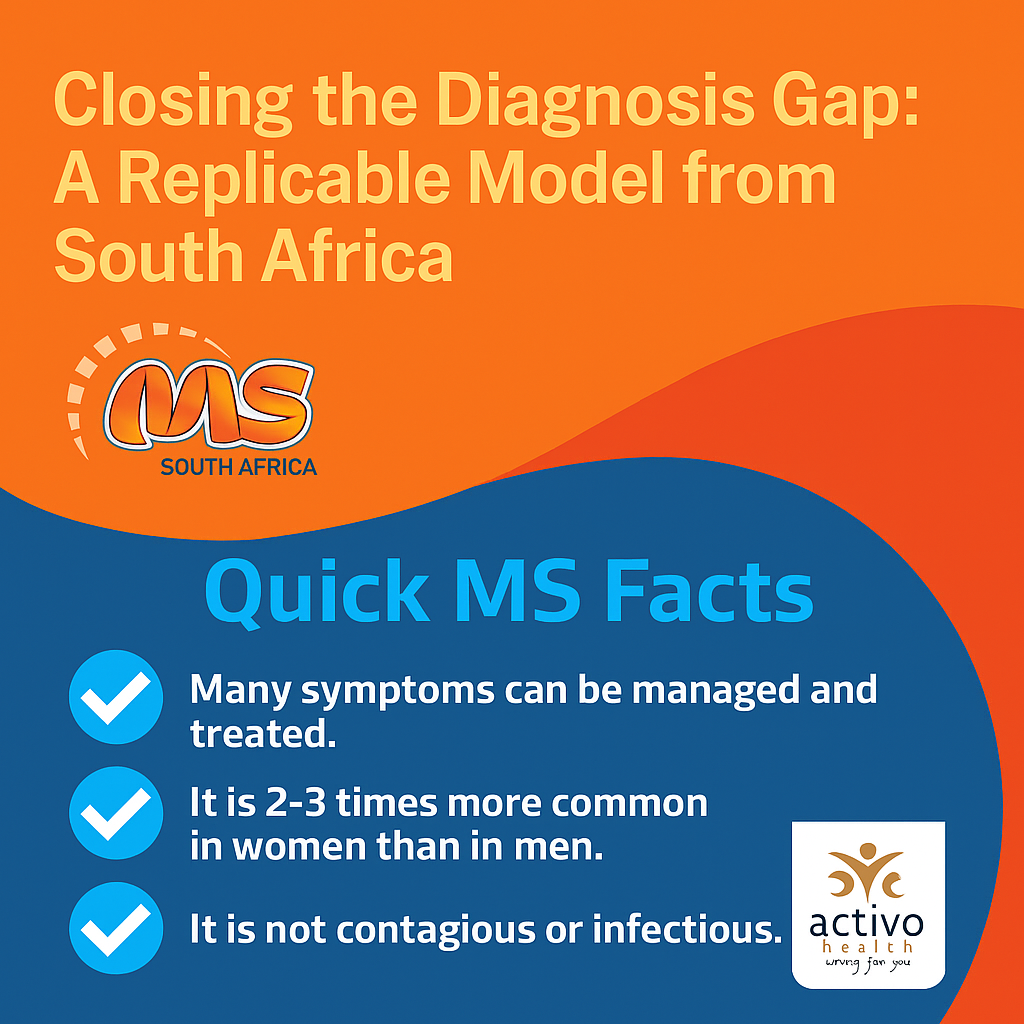
A three-part GP Upskilling Series with Dr Dion Opperman, made possible through a grant from Activo Health.
Why This Series Matters
Across South Africa — and much of the world — people with multiple sclerosis (MS) continue to face late or incorrect diagnoses, often after years of unexplained symptoms. The consequence is not only emotional and physical distress, but also accumulated, irreversible disability that could have been slowed or prevented with earlier intervention.
This blog introduces a three-part educational video series by Dr Dion Opperman, neurologist and member of the MSSA Medical & Scientific Advisory Board, created to upskill general practitioners (GPs) and frontline healthcare professionals.
The project was born from the urgent need to address delayed diagnosis and strengthen the referral pathway between primary care and specialist neurology. It was made possible through the support of Activo Health, whose grant enabled the series’ recording and professional production — a first of its kind for South Africa.
The Impact of Delayed Diagnosis
When MS is diagnosed late, treatment options narrow and outcomes worsen.
-
Early and accurate diagnosis allows for the initiation of disease-modifying therapy (DMT), reducing relapses and long-term disability.
-
Late diagnosis, however, shifts the focus to managing complications, preserving function, and improving quality of life.
-
The difference between these paths often lies in the GP’s ability to recognise MS early — understanding when a constellation of seemingly unrelated neurological symptoms warrants referral to a neurologist.
This is where education makes a tangible difference — and where this series begins.
The Educational Series: Scroll to Watch
Each video builds on the last, offering GPs clear, locally relevant guidance for improving MS outcomes from the very first consultation.
Episode 1 – Understanding Multiple Sclerosis: Recognising the Red Flags
Dr Opperman explains the underlying mechanisms of MS, the hallmark signs and symptoms, and how subtle or transient neurological changes can be easily overlooked in general practice.
Key points:
-
How MS affects the central nervous system
-
Typical early signs: vision loss, balance changes, numbness, fatigue
-
Diagnostic workup and MRI interpretation essentials
-
When to suspect MS and refer for specialist assessment
Episode 2 – Treatment Pathways and Monitoring: What GPs Need to Know
This episode focuses on treatment initiation and continuity, giving primary-care clinicians an overview of current DMT options in South Africa and the GP’s role in ongoing patient support.
Key points:
-
Disease-modifying therapies: what’s available and how they work
-
Addressing access barriers in private vs. public sectors
-
GP’s monitoring responsibilities (safety, side effects, adherence)
-
Supporting informed, shared decision-making
Episode 3 – Living Well with MS: The GP’s Perspective
The final session explores how to sustain long-term wellness in MS, highlighting the GP’s pivotal role in managing fatigue, pain, mental health, and comorbidities.
Key points:
-
Managing cognitive and emotional changes
-
Referring to allied professionals (physio, neuropsychology, OT)
-
Lifestyle interventions that preserve brain health
-
Coordination of care for better patient outcomes
From Local Practice to Global Progress
The launch of this South African GP Upskilling Series aligns with global conversations at ECTRIMS 2025, where new research continues to refine how MS is diagnosed and treated.
The updated McDonald diagnostic criteria — expected to integrate advanced MRI markers, spinal fluid analysis, and emerging biomarkers of neuroinflammation — promise earlier and more accurate identification of MS than ever before.
But these advances will only reach patients if frontline clinicians know what to look for.
This is why this series is more than education; it’s a replicable model for health system strengthening. By starting with the doctors who first see the patient, MSSA is helping close a diagnostic gap that has persisted for decades across Africa.
Acknowledgement
MSSA extends sincere appreciation to Activo Health for their collaboration and funding support, and to Dr Dion Opperman for his ongoing contribution to improving MS care, education, and patient outcomes in South Africa.
Learn More and Get Involved
-
Explore more MSSA educational resources: https://www.multiplesclerosis.co.za
-
Join the MSSA professional network or support groups: https://bit.ly/3HnZeHw
-
Contact: non@multiplesclerosis.co.za
Multiple Sclerosis South Africa (MSSA)
Advancing early diagnosis, equitable access, and informed care across the MS landscape.
— Non Smit (CEO) Team MS South Africa