
Why Patient Advocacy Must Be Built on Relationships, Not Numbers
In the digital age, patient organisations are increasingly encouraged to measure their success through numbers.
Followers.
Subscribers.
Channel members.
Audience reach.
Digital platforms now make it possible to gather thousands of people around a disease or condition with a single click. From the outside, this scale can appear impressive — even powerful.
But an important question remains:
Does having access to large numbers of people truly mean we are advocating for them?
After more than three decades working alongside people living with multiple sclerosis, I have come to understand that genuine advocacy rarely happens through scale alone. It happens through relationships, trust, and a deep understanding of the realities people face in their daily lives.
Over the past few years I have observed the rapid growth of communication tools that allow organisations to broadcast information to large audiences — often anonymously and at scale. These platforms certainly have their place in raising awareness.
However, they represent a very different model from the one we have intentionally built at Multiple Sclerosis South Africa (MSSA).
Our work is not built on accumulating followers.
It is built on knowing the people we represent.
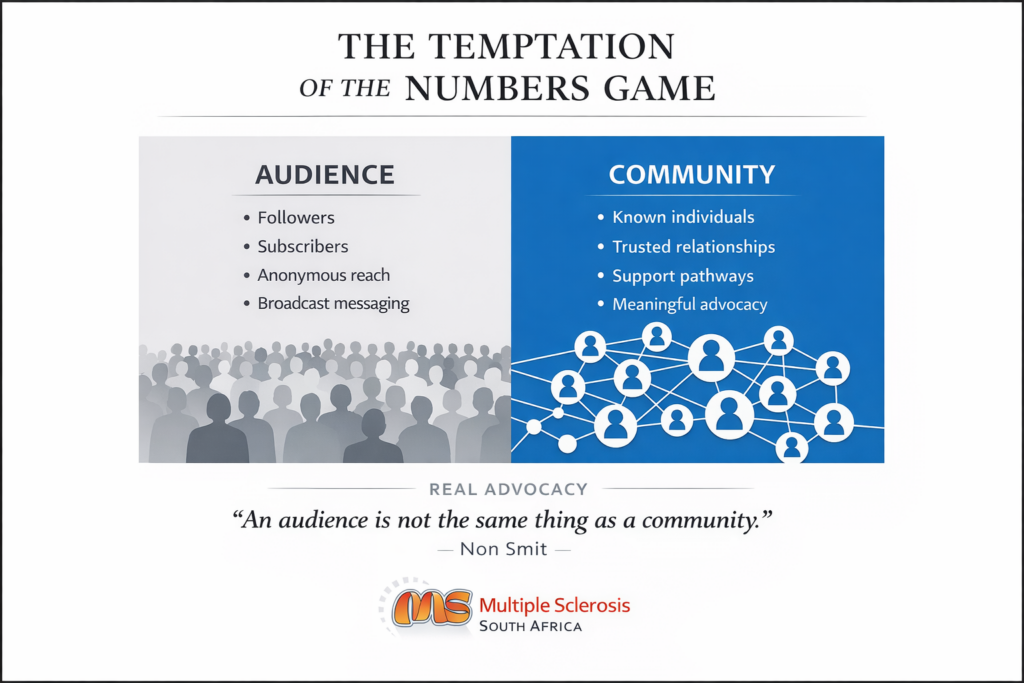
The Difference Between an Audience and a Community
Digital platforms often create what could be described as an audience model.
People can subscribe, follow or join channels anonymously. Information flows outward from an organisation to large numbers of recipients, often without meaningful interaction or context.
This model can be effective for awareness campaigns. But when it comes to patient support and advocacy, it has clear limitations.
In many cases:
• you do not know who the individuals are
• you do not know where they live
• you do not know their diagnosis stage or treatment status
• you do not know the barriers they are facing
• you cannot meaningfully connect them with services or care pathways
In other words, reach does not necessarily translate into representation.
“An audience is not the same thing as a community.”
— Non Smit
Why MSSA Chose a Relationship-Based Ecosystem
At MSSA we made a deliberate decision many years ago to build our work on a different foundation.
Our guiding principle is simple:
“If we are going to advocate for someone, we must know who they are.”
Individuals who wish to be part of the MSSA community complete a registration process. This allows us to understand their circumstances and ensures that the support we provide is both meaningful and responsible.
Over time this has allowed MSSA to build what can best be described as a relationship-based ecosystem.
Within this ecosystem we are able to understand:
• where people are located across South Africa
• which neurologists and healthcare services they access
• what treatment pathways they are navigating
• what barriers they encounter within medical aid or public health systems
• what forms of peer support are most valuable to them
This structure allows us to do far more than simply share information.
It enables us to connect people, identify patterns, guide individuals through complex systems, and advocate with evidence grounded in lived experience.
Advocacy Requires Context, Not Just Communication
In the field of chronic illness, advocacy is rarely simple.
People living with multiple sclerosis must navigate complex systems that affect nearly every aspect of their lives, including:
• access to diagnosis
• treatment authorisations
• medical aid protocols
• disability and workplace issues
• long-term disease management
• emotional and psychological adjustment
These challenges cannot be addressed through anonymous broadcasting alone.
They require context, understanding and trust.
Because MSSA knows the individuals within our network, we are able to support them in ways that go far beyond information sharing. We can listen carefully, guide decisions, connect individuals with appropriate professionals, and advocate with evidence grounded in real experiences.
This depth of engagement is what allows advocacy to become effective rather than symbolic.
A Different Measure of Success
The success of MSSA is not measured by how many anonymous subscribers we can gather.
It is measured by something far more meaningful:
• the relationships we build
• the trust within our community
• the guidance people receive during moments of uncertainty
• the support that becomes available when someone needs it most
Over the years this approach has allowed us to walk alongside thousands of individuals living with multiple sclerosis across South Africa, helping them navigate a journey that is often complex and deeply personal.
Our community is not an audience.
It is a network of people who know that MSSA understands their reality and will walk alongside them when the path becomes difficult.
Building Advocacy That Truly Represents People
Digital tools will continue to evolve, and new platforms will undoubtedly emerge. Each organisation must decide how these tools fit within its mission and values.
For MSSA, the principle remains clear:
Advocacy must be rooted in relationships.
True representation requires knowing the people behind the statistics — understanding their stories, their challenges, and the realities they face every day.
Numbers may tell part of the story.
But genuine advocacy always begins with people.
Non Smit
Chief Executive Officer
Multiple Sclerosis South Africa (MSSA)